
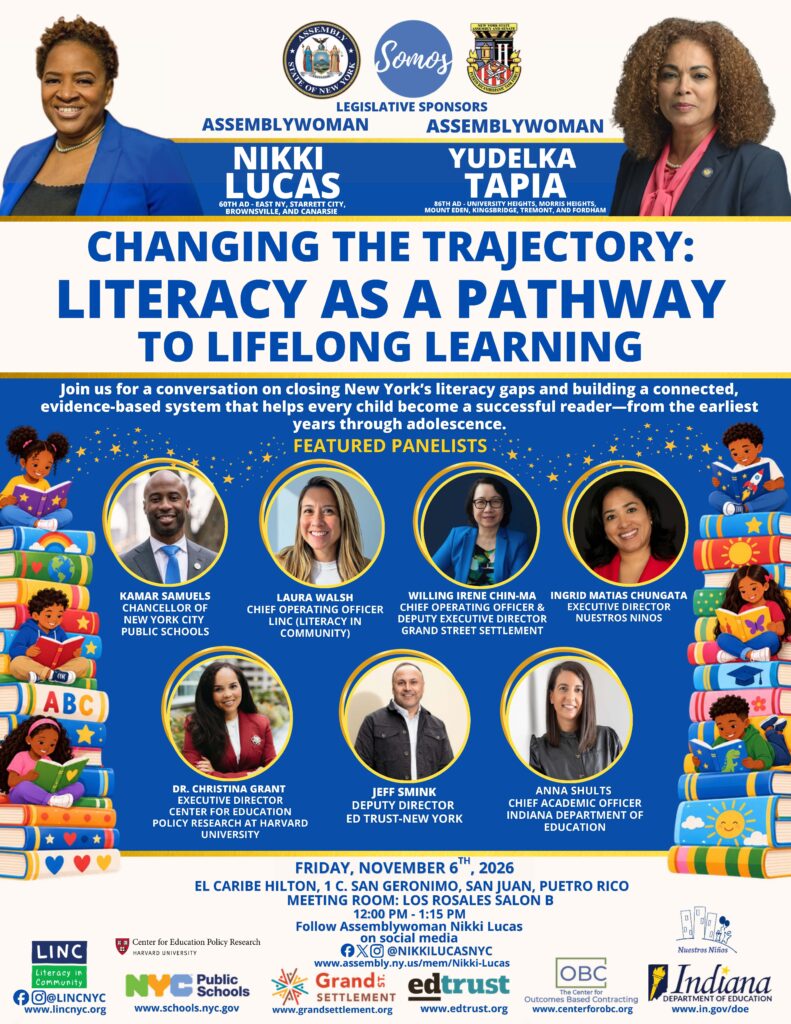
On November 6, Literacy in Community (LINC), EdTrust New York, and Really Great Reading will present Changing the Trajectory: Literacy as a Pathway to Lifelong Learning at SOMOS 2026.
Join us for a conversation on closing New York’s literacy gaps and building a connected, evidence-based system that helps every child become a successful reader—from the earliest years through adolescence.
Panelists Include:
- Kamar Samuels, Chancellor of New York City Public Schools
- Laura Walsh, Chief Program Officer- LINC (Literacy in Community)
- Willing Irene Chin-Ma, Chief Operating Officer and Deputy Executive Director, Grand Street Settlement
- Ingrid Matias Chungata, Executive Director, Nuestros Ninos
- Jeff Smink, Deputy Director, Ed Trust
- Anna Schults, Chief Academic Officer, Indiana Department of Education
- Dr. Christina Grant, Executive Director, Center for Education Policy Research at Harvard University
For 40 years, SOMOS has fought for the promise that every New Yorker can take part fully in the life of this state. Reading is where that promise is kept or broken. Only 41 percent of New York fourth graders read proficiently on the 2024 NAEP. For Latino fourth graders, it is 28 percent, and more than half score below basic. These are not simply fourth-grade reading scores. They are signals of trajectories that begin years earlier and, without effective action, become harder to change with every passing year.
These gaps do not open overnight. They open at the seams of our system: between the pediatrician’s office and the childcare classroom, between prekindergarten and kindergarten, and between third grade, when children are expected to have learned to read, and middle school, when they must read to learn. Every seam is a gap year. Our children, especially Latino students and multilingual learners, are the ones who fall through.
New York has started. The Back to Basics plan sets the direction, and New York City’s historic 2K rollout is opening doors for our youngest learners. But access and policy language are not outcomes. More than 130 districts still report using balanced literacy curricula, and New York remains one of the last states without a comprehensive framework for the science of reading. The question now is whether New York can connect its investments—from the earliest years through adolescence—into a literacy system built around a clear expectation: every learner becomes a successful reader, and we measure whether what we are doing is actually getting them there.
That requires thinking beyond programs, grade bands, and institutional boundaries. Children do not experience literacy as a succession of initiatives. Their trajectory is shaped by the adults and environments around them—from families, pediatricians, childcare providers and libraries to teachers, schools, districts and state leaders. When that ecosystem works together, strong language and literacy development can begin long before kindergarten. When students need additional support later, schools must be able to identify what they need, deliver instruction grounded in evidence, and know whether it is working quickly enough to alter their trajectory.
This panel treats literacy as one continuous pathway, not a series of handoffs. LINC begins at the foundation, building the literacy infrastructure of the birth to five years: the adults, classrooms, clinics, libraries, and partnerships that raise readers before kindergarten. EdTrust New York maps the state landscape, the lessons from other states, and the policy framework in the Right to Read Act. Really Great Reading brings a complementary challenge to the conversation: what changes when we stop measuring success by what schools purchase or providers deliver and start measuring whether students actually become better readers?
The opportunity for New York is larger than any single literacy initiative. It is to build a continuous system in which children begin developing the foundations for reading from birth, receive evidence-based instruction when they enter school, get effective intervention whenever they need it, and never reach adolescence without a system urgently working to change their trajectory.
Universal childcare is the promise. A reading pathway with no gap years is how we keep it. Universal childcare can expand the opportunity to reach children. A coherent literacy system can turn that opportunity into outcomes. The measure of success is not what New York provides—it is whether every child learns to read.
Attend this panel and leave with the following:
- A shared map of the pathway. A clear view of literacy from birth through grade 8, naming the transitions where readers are most often lost and the infrastructure that closes each gap, starting with the birth to five years.
- A standard for high quality implementation. What strong science of reading instruction looks like at every stage, what multilingual learners need, and why professional learning for early childhood and middle school educators is the most overlooked investment in the system.
- An accountability model New York can use. How contracting based on student outcomes works, a model from Indiana, and how to take that model to New York, legislatively and in district practice.
- A legislative path and a personal commitment. The policy steps state leaders can take in the 2027 session, including the Right to Read Act, and one concrete commitment from each panelist and attendee to close a gap year in their own community.
We are incredibly grateful to our sponsors Assemblymember Yudelka Tapia (86th District) and Assemblymember Nikki Lucas (60th District) for making this panel possible.