LINC’s Impact in
the Community
Literacy is crucial. It impacts nearly every major positive life outcome. Too many children arrive at school without the necessary literacy skills to succeed. LINC is changing that.



Reaching Children When It Matters Most
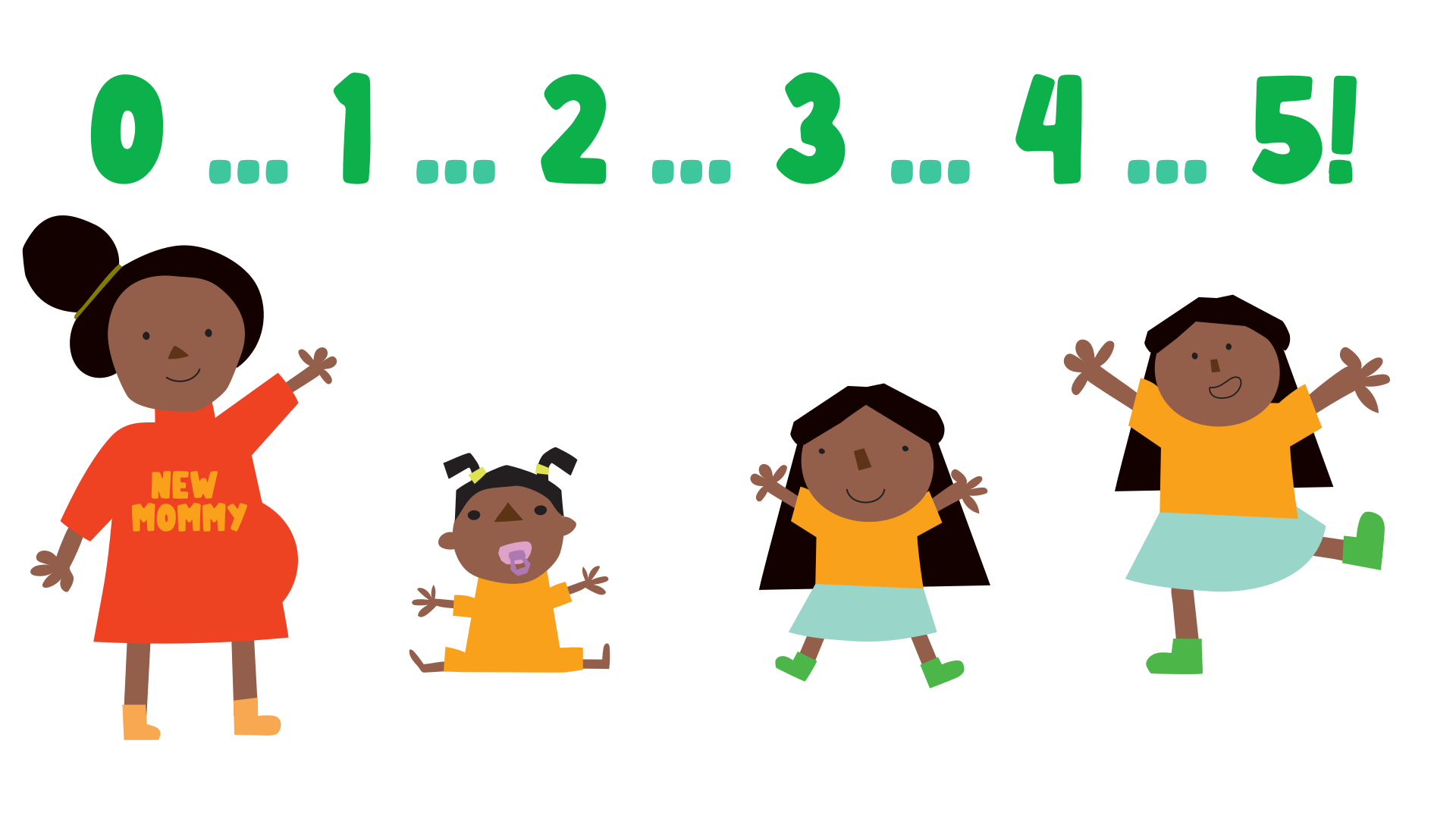
90% of a child’s brain development occurs between birth and age five, including literacy skills that build language, attention, cognition, and social and emotional awareness.
Literacy Starts at Birth
Surrounding children with a literacy-rich environment from day one is essential to solving the literacy crisis.
- High-quality early childhood education focused on birth to five years of age generates a 13% return on investment per child per year.
- These programs improve childrens’ academic success, leading to higher test scores, reductions in special education, grade retention, and decreased school drop-outs.
- Compared to later remediation, funding early childhood literacy is cost-effective and has a high, long-term return.
- Early literacy must be embraced as part of the education continuum for us to solve the literacy crisis.
Without action, we miss the critical early years

50% of children arrive at kindergarten already behind in literacy. The consequences can be devastating.
- Once behind, many children stay behind measurably and persistently.
- Children who are not reading proficient by third grade are 4x more likely to not finish high school by age 19 and 6x more likely if they are of low income.
- They are less likely to be stably employed as adults.
- They are 5x more likely to have contact with the criminal justice system.
 LINC Builds Literacy From Day One
So all children arrive at the schoolhouse door ready to read and to learn.
LINC’s programs successfully increase parents’ and caregivers’ knowledge about their children’s literacy development and how to impact it through meaningful literacy routines at home that also build relational health.
96%
of caregivers read five or more days a week to their child
98%
of caregivers say LINC has helped their child advance

88%
of caregivers ask their child questions about what they’re reading
88%
of caregivers talk about the feelings of the characters in the stories they’re reading
75%
of caregivers with children younger than five report reading five or more days a week to their child
85%
of primary school caregivers report LINC helped them become more aware of their child’s reading goals
95%
of caregivers report they understand the importance of reading with their child
Community-Powered Impact
LINC leverages community partners to make literacy visible and valued across neighborhoods.
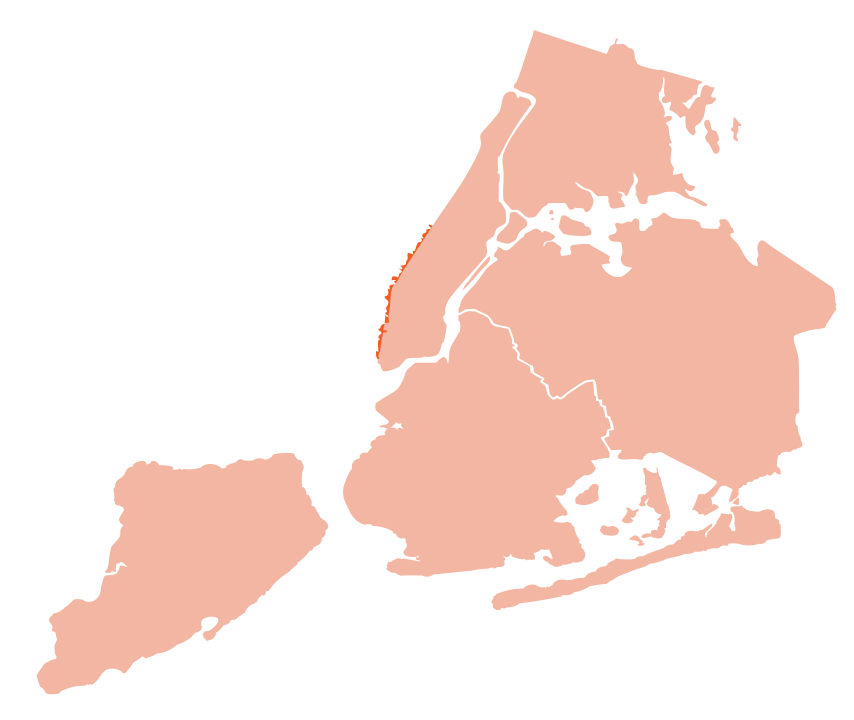
Our core programming is delivered in eight neighborhoods across New York City’s five boroughs. Beyond these communities, we deliver a growing variety of programs and advocacy efforts to young readers across New York state.
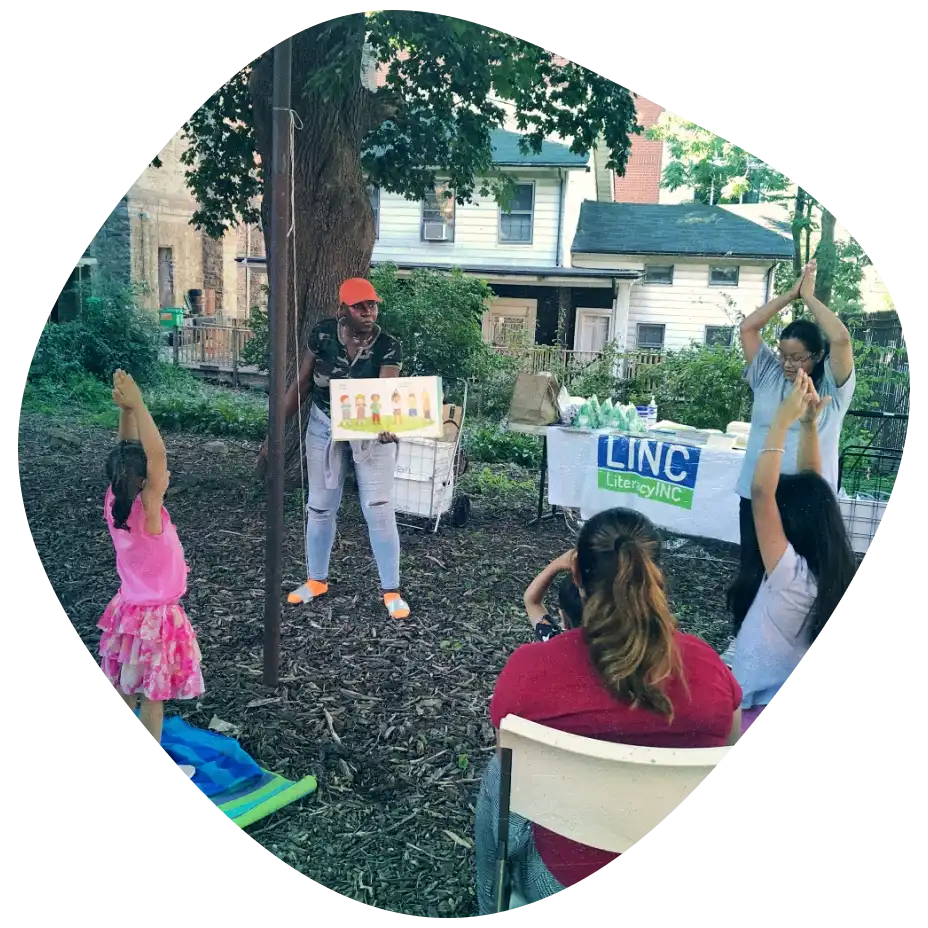
We identify community partners to collaborate with over the course of a year. These include day cares, medical offices, public parks, libraries, schools, and other community spaces.
With each partner, we offer science-informed caregiver workshops, partner orientations, and additional community reading events to educate and mobilize families to inspire lifelong learning habits for their little ones and other children in their community.
Our community efforts are supported by a host of additional programming targeted to create impact in our neighborhoods and across New York, one family at a time.
By the numbers
200
community partners work with LINC every year to host LINC programs and share literacy resources
35
LINC Literacy Zones are hosted by our partners, providing mini-libraries in community spaces where families can read a book and take one home for free

Hear from
Alan Mendelsohn
Director, Division of Developmental-Behavioral Pediatrics, NYU Grossman School of Medicine and NYC Health+Hospitals/Bellevue and Founding Director and Principal Investigator, PlayReadVIP
LINC is one of the most effective early childhood organizations that I have ever come across. It is incredibly innovative in its bringing together proven programs across communities, libraries, homes, early education, child care and child health care – everywhere families with children can be reached – to support parents and other caregivers in reading aloud with their children. LINC’s programs help children become ready for excelling in reading and achieving in school.
30 Years of Community-Powered Literacy
From its beginning, LINC has embraced parents and caregivers as powerful agents in their children’s literacy development long before school. Yet many families don’t have access to the resources to support their children’s literacy journeys. LINC set about to change that. Literacy is an education issue and an equity issue.
Today, our programs and workshops reflect three decades of experience working with families. All of our programs and workshops are grounded in the science of reading, and our focus on working with partners and on professional learning is creating a multiplier effect that ripples across communities.
For every child to reach school ready to read and learn, literacy must start at birth. We are leading the way on ensuring that literacy in the 0-5 years is embraced as part of the education continuum and prioritized in the policies and practices that touch families in the earliest years of their children’s lives.
Our recently adopted strategic plan will guide LINC’s work going forward to reach more children earlier in their lives, to continue lowering barriers for parents, caregivers, and communities to own their power as agents of literacy, and to instill the centrality of early literacy in the systems that support children and families.
Literacy is powerful. All children deserve the lifelong benefits of literacy.