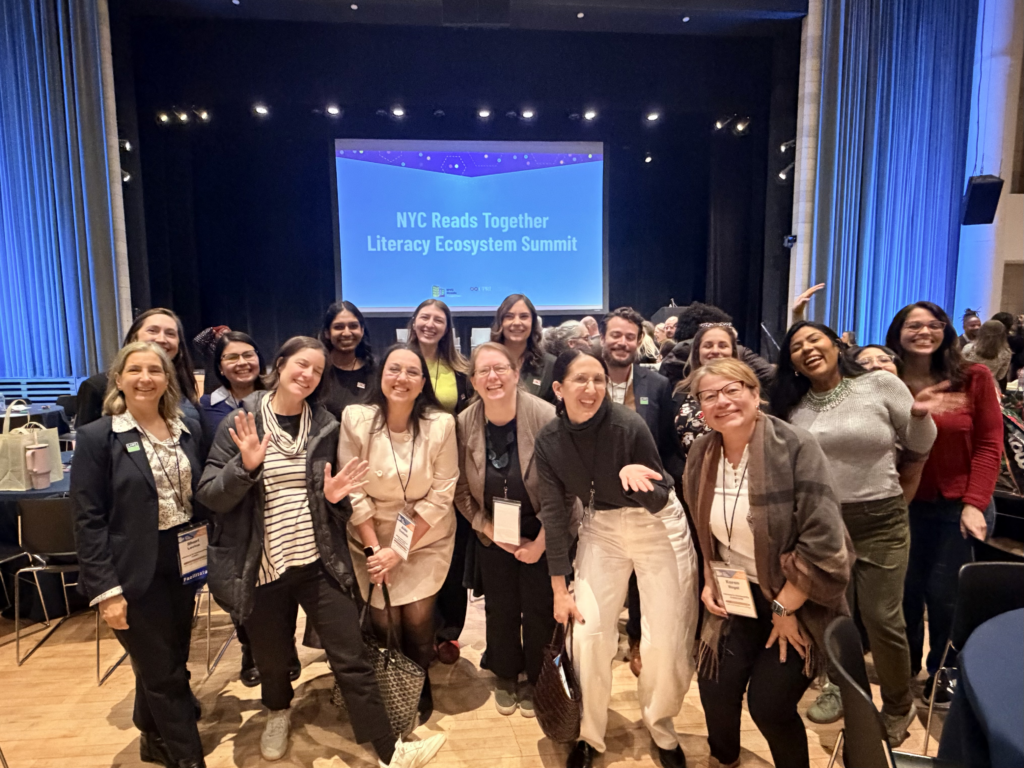
Last week, leaders from across New York City’s education, nonprofit, research, and policy sectors came together for what many are calling a historic moment for early literacy: the NYC Reads Together Literacy Ecosystem Summit. Organized by the Center for Public Research and Leadership (CPRL) at Columbia University, this convening brought together an extraordinary group of leaders—from NYC Public Schools Chancellor Kamar H. Samuels and SUNY Chancellor John B. King, to NYC Department of Youth and Community Development Commissioner Sandra Escamilla-Davies and Council Member Eric Dinowitz—alongside practitioners, researchers, and community organizations working on the frontlines of early learning.
What emerged was more than alignment. It was a shared commitment to a collective goal: ensuring that every child in New York City is reading on grade level by 2035.
LINC was proud not only to participate in this moment, but to help shape it.
Across multiple sessions, LINC’s leadership advanced a clear vision for what it will take to get there—one where families, educators, healthcare providers, and community organizations are all working from a shared map. In “When the Village Shares the Map,” LINC’s Executive Director, Shari Levine, and Chief Program Officer, Laura Walsh, highlighted the importance of building a seamless early literacy pathway from prenatal support through kindergarten readiness.
In partnership with City’s First Readers, LINC also helped lead “Building Public Will: The Early Literacy Ecosystem Approach,” focused on aligning messaging, strengthening coordination across sectors, and accelerating progress toward the city’s 2035 goals. Together, these conversations reinforced a critical truth: lasting change will require not only strong programs, but shared language, shared responsibility, and sustained public will.
A few central ideas took hold across the summit, ideas that LINC has not only championed, but helped bring to the forefront of the field.
First, the recognition that literacy begins at birth and that early childhood must be fully integrated into the education continuum. Learning does not start in kindergarten—it starts in a child’s earliest relationships and experiences, and must be intentionally supported from the very beginning.
Second, the shift from universal child care to universal literacy. Access to care is essential, but it is not enough. Every setting that serves young children must also be equipped to support their language and literacy development, and every family must be recognized and supported as a central partner in that process.
Through sustained advocacy, partnership, and on-the-ground practice, LINC has helped shape this evolving framework—advancing a more integrated, family-centered vision for early literacy and influencing how leaders across the city approach this work. What was once a fragmented set of ideas is now coalescing into a shared direction for the field.
LINC’s Deputy Executive Director, Eliana Godoy, also joined citywide partners in a panel on the NYC Reads Neighborhood Initiative, highlighting how hyperlocal collaboration can strengthen outcomes for children and families. And in a featured discussion on bridging policy and implementation, moderated by The New York Times education reporter Troy Closson, leaders across government and higher education underscored the importance of translating ambition into real, sustained impact on the ground.
Throughout the summit, LINC’s work was recognized by city leaders and partners as a model for engaging families and embedding literacy into everyday community spaces. These moments reflect something larger: LINC is helping to shape the citywide agenda for early literacy and build the public will needed to drive lasting change.
At the same time, the summit made clear that this work is just beginning. While progress is underway, significant challenges remain—and addressing them will require continued alignment, learning, and coordination across systems. What stood out most, however, was the collective willingness of stakeholders to roll up their sleeves and do the work with accountability, responsibility, and relentlessness.
As Chancellor King reflected, what has often been called the “Mississippi Miracle” is better understood as a marathon. New York City is embracing that same mindset: sustained, collective effort over time to ensure lasting results for children.
This is where LINC’s model matters most.
For nearly a decade, LINC has advanced a family-centered, community-driven approach to literacy—one that integrates the science of reading with play-based learning and positions families as essential partners in their children’s development. As the city moves toward a more aligned, ecosystem approach, and toward a future of universal literacy, LINC is uniquely positioned to help bridge the gap between research, policy, and practice.
The momentum is here. The partnerships are growing. And the opportunity to scale what works, especially family-centered approaches, is within reach.
Now is the time to act.
At LINC, we are committed to continuing to lead, partner, and advocate so that every child, regardless of background or zip code, enters school ready to thrive as a reader. We invite our partners, supporters, and community to join us in turning this historic moment into lasting change.
For more information about Literacy in Community (LINC) or City’s First Readers (CFR), please contact communications@lincnyc.org.