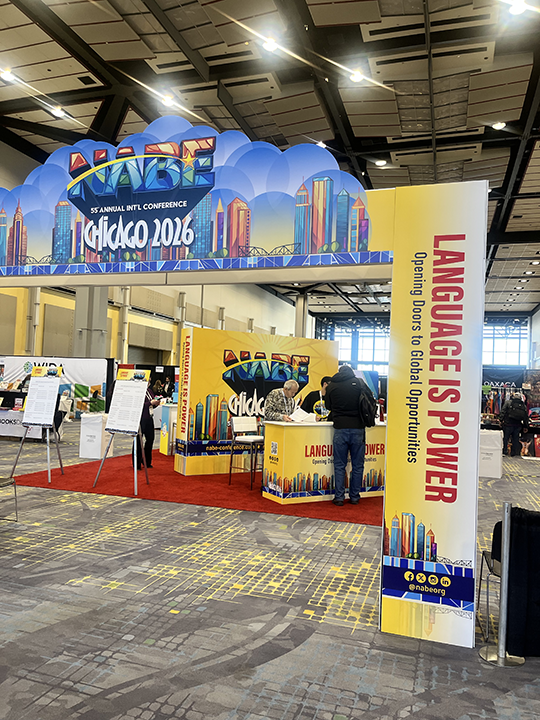
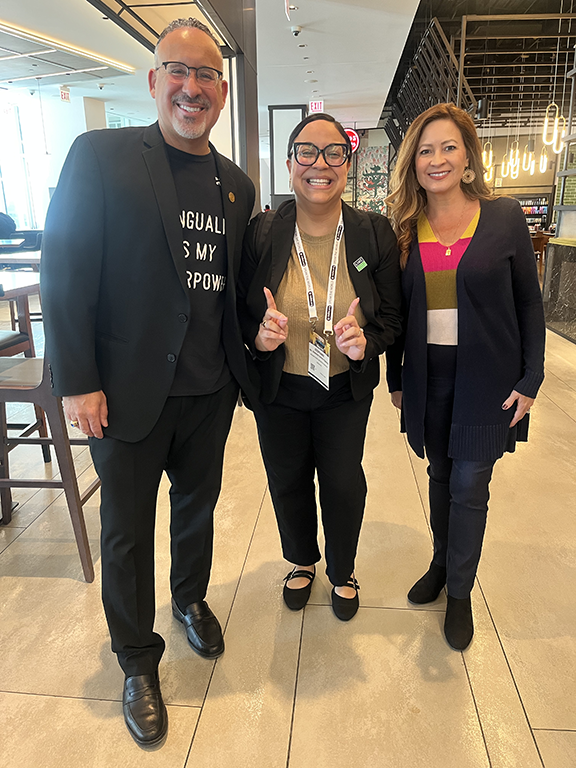
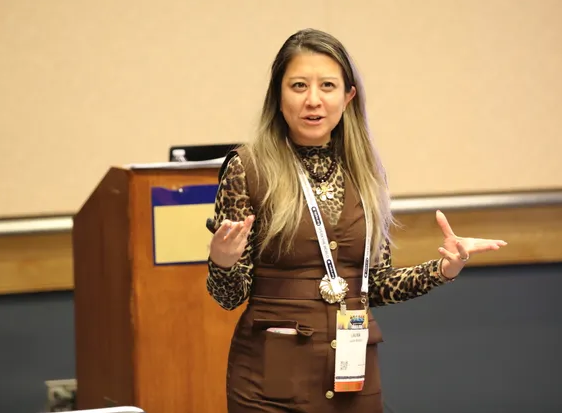
From February 9-13, LINC’s Chief Program Officer, Laura Walsh and Bilingual Content and Delivery Specialist, Stephanie Santos, joined educators from around the world advocating for the power of bilingual programming at the National Association for Bilingual Education (NABE)’s 55th annual conference in Chicago.
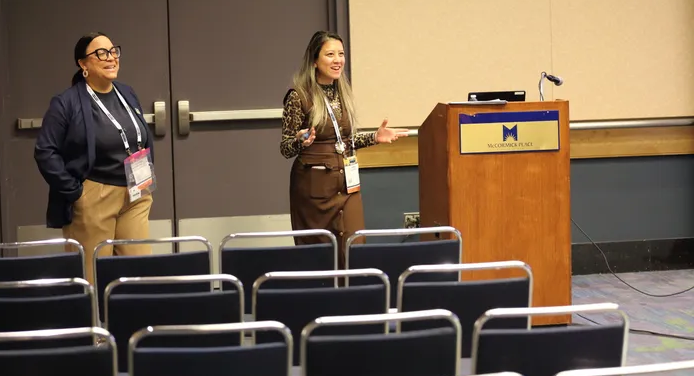
Laura and Stephanie presented Play, Partner, Progress: A Bilingual Approach to Family-Educator Literacy Engagement and described how Literacy in Community (LINC) partners with families and educators to support early literacy development in culturally and linguistically diverse communities.
LINC’s new “LINCubator” model pairs professional learning for educators with parent workshops, introducing low-lift, high-impact literacy games rooted in the science of reading. Stephanie and Laura demonstrated these activities for attendees and shared early outcomes from partner schools. They also explored the research behind the model, giving participants ready-to-use materials and a deeper understanding of how aligned family-school engagement can accelerate literacy growth in bilingual settings.
NABE’s* annual conference is a unique opportunity for professionals in the United States dedicated to exploring topics of interest for teachers, administrators, and parents of English learners (ELs), which include dual language education, second language acquisition, bilingual education, assessment and accountability, teacher training, special education, and grassroots activism. NABE speaks to LINC’s culture of learning, and we are proud to be part of its unique community. LINC’s participation last year influenced our professional development, and we are excited to integrate our 2026 learnings into future programs and workshops.
For more information about the LINCubator, please contact Laura Walsh, lwalsh@lincnyc.org and to register for a program, visit us at www.lincnyc.org.
__________________________________________
* The National Association for Bilingual Education (NABE) is the only national professional organization devoted to representing bilingual/multilingual students and bilingual and dual language education professionals. NABE has 20 state/regional affiliates and 4 international affiliates, which collectively represent more than 5,000 members. These members include bilingual and English learner (ELs) teachers, parents, paraprofessionals, administrators, professors, advocates, researchers, and policymakers.